
A Home Environment That Looks After Its People
This is the comfort and independent-living side of a smart home: air quality you can actually see a number for, lighting that follows the sun through a dark prairie winter, and unobtrusive technology that helps an older parent stay in their own home for longer. It is environmental and awareness technology — not medical equipment, and we’re precise about that difference throughout.
- Designed with the person, not around them
- Runs in the home, not in a cloud
- No subscription to use your own home
Three different jobsthat people usually lump together
"Health and wellness" in a smart-home catalogue tends to be a vague pile of gadgets. In practice the people who call us about it want one of three concrete things, and they’re worth separating because the answers are different.
- Air. Knowing whether a stuffy room, a smoky August week or a dry January is actually measurable — and getting ventilation to respond without anyone thinking about it.
- Light. Making a house feel decent through months where you leave for work in the dark and come home in the dark.
- Independence. Helping an older family member stay in their own home safely, without turning that home into a surveillance exercise.
We’ll say plainly what each one does and doesn’t do.
Measurable air, considerate light, quiet support
Indoor air-quality monitoring
Sensors that report CO₂, humidity and particulate levels room by room. You stop guessing whether a room is stuffy and start seeing the number.
Automated ventilation response
Where you already have an HRV or ventilation system, we can trigger it from what the sensors read rather than a fixed timer. The mechanical side stays with your HVAC contractor; we do the controls.
Humidity awareness
Prairie winters are very dry and shoulder seasons cause condensation. Seeing the number is how you stop static, protect wood floors and catch wet window sills early.
Light that follows the day
Bright, cool mornings and warm, low evenings on an automatic schedule that tracks sunrise and sunset. See lighting & shading for the full picture.
Independent-living support
Gentle awareness for families: lights that make a safe night path, a simple check-in, and optional activity notifications — always set up with the knowledge and agreement of the person living there.
Peace-of-mind monitoring
Water leak detection, temperature floors and door awareness in a home that’s lived in alone. Practical things that catch a problem early — see leak protection.
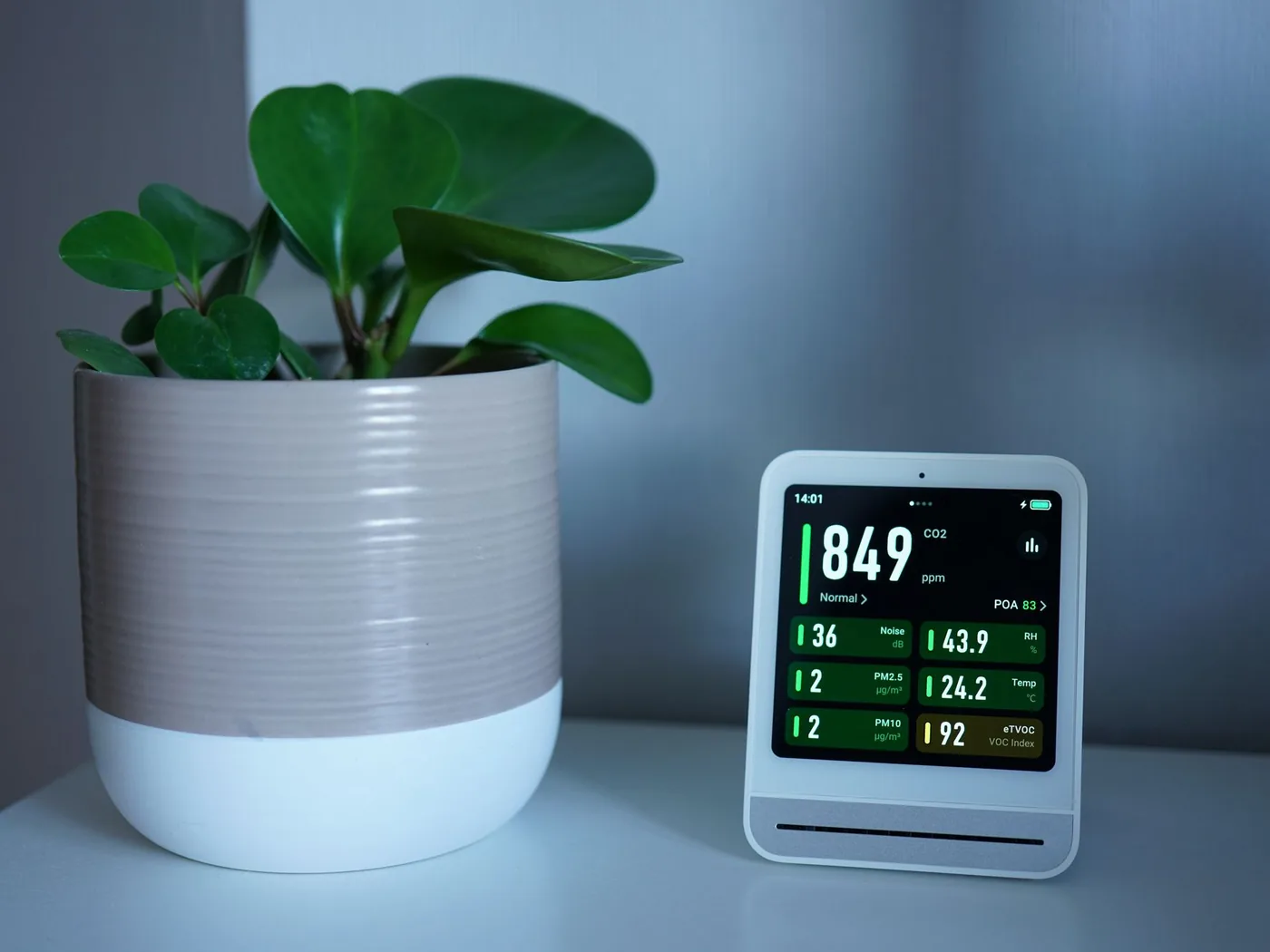
You cannot improve air you have never measured
Carbon dioxide, fine particulate, humidity and temperature on a single readout. In a house sealed tight against a prairie winter, CO₂ climbs overnight in a closed bedroom and humidity swings hard between seasons. Both are straightforward to fix once you can see them, and pure guesswork until you can. Illustrative photograph, not one of our installations — our own project photos are marked “from our work”.
How it works hereA sealed prairie house has its own air story
We shut our houses for six months. Homes here are built tight and stay closed through winter, which is good for heating bills and means indoor air gets very little natural exchange. CO₂ climbing in a closed bedroom overnight is a measurable, ordinary thing — and it’s invisible without a sensor.
Winter air is genuinely dry. Static shocks, cracking trim and gaps opening in hardwood are the everyday signs. A humidity reading turns that from a mystery into a number you can act on.
Wildfire smoke is now a normal part of summer. On smoky weeks, a particulate reading is what tells you whether keeping the windows shut and running filtration is actually doing anything — rather than guessing from how the sky looks.
Winter darkness is the light problem. Around the solstice Saskatoon gets roughly seven and a half hours of daylight, with the sun down before five. Lighting that shifts warm in the evening and bright in the morning changes how a house feels for months at a time.
What this is not
- This is not medical equipment and we make no health claims. We install sensors that measure air and automations that control lights and ventilation. We do not diagnose, treat, monitor or improve anyone’s health, and any company telling you a smart-home product does is selling you something they can’t stand behind.
- It does not replace a medical alert service. If what you need is a monitored fall-detection or emergency-response pendant, that is a different, certified product and you should have one. What we install can sit alongside it — it cannot substitute for it.
- Activity awareness is not surveillance, and we won’t build it as such. No cameras in private spaces. The person living in the home is our client too, they know exactly what is installed, and they can say no to any part of it. If a family wants monitoring the resident hasn’t agreed to, we’re the wrong company.
- Air monitoring tells you the number, not the cure. If readings show a real ventilation problem, the fix is often mechanical — an HRV, a bathroom fan that actually vents, or an HVAC contractor. We’ll tell you when that’s the answer.
Where people usually start
Priced at the free assessment with a fixed quote before any work begins. The independent-living work in particular is designed per household, in conversation with everyone involved.
Air Awareness
fixed quote on site
Air-quality and humidity monitoring in the rooms that matter, set up so you can see readings over time rather than one instant number, plus a plain review of what they show.
Comfort Light & Air (most popular)
fixed quote on site
Monitoring plus automated ventilation response where you have the equipment for it, and lighting scenes that follow the sun through the whole year.
Independent Living
custom quote
Designed with the household — safe night lighting, door and activity awareness at whatever level the resident agrees to, leak and temperature protection, and a simple way for family to check in.
How we approach the independent-living conversation
- Everyone in the room. We do the assessment with the person who lives there, not just the family member who called. They decide what goes in.
- Least intrusive option that solves the actual worry. Usually the worry is specific — a dark hallway at night, a stove, a basement stair, whether the day has started normally. Each has a modest answer that doesn’t require watching anybody.
- Show exactly what it does. Before anything is switched on, we show the household what is recorded, what is not, who can see it, and how to turn any of it off. Consent is a requirement, not a feature.
Serving Saskatoon, Warman & Martensville
Free on-site assessments in Saskatoon, Warman and Martensville. Elsewhere in Saskatchewan, book a free online consultation.
Frequently asked questions
Is this medical monitoring?
No. We install environmental sensors and home-automation technology. It does not diagnose, treat or monitor any medical condition, and it complements rather than replaces medical alert services, professional care or advice from a doctor. We’re deliberate about that line because plenty of smart-home marketing isn’t.
Will my parent feel watched?
Not if it’s designed properly, and that’s mostly a design question rather than a technology one. We do the assessment with the person living there, use the least intrusive option that addresses the actual concern, put no cameras in private spaces, and show them exactly what is and isn’t recorded. If a family wants something the resident hasn’t agreed to, we won’t install it.
What does air-quality monitoring actually measure?
Typically carbon dioxide, relative humidity and fine particulates, per room, over time. That tells you when a closed room is getting stuffy, whether your winter air is as dry as it feels, and what indoor particulate levels are doing on a smoky day. It reports conditions — what you do about them is a separate decision, and sometimes a mechanical one.
Does it help on wildfire smoke days?
It tells you what indoor particulate levels are doing, which is the information you’re otherwise missing. Whether closing up and filtering is working stops being a guess. We’re describing measurement here, not a health outcome.
Does lighting really change how a house feels in winter?
Most people notice it, and at this latitude there’s a lot of dark to work with — roughly seven and a half hours of daylight around the solstice. Warm evening light and brighter mornings on an automatic schedule make rooms feel considerably better through the season. We’re happy to demonstrate it rather than argue about it.
Can this work with ventilation equipment I already have?
Often, yes — we can trigger existing ventilation from sensor readings instead of a fixed timer. The controls side is ours; the mechanical side stays with your HVAC contractor, and we’ll say clearly which is which.
Where does the data go?
It stays in your home. Readings and automations run on hardware you own, and nothing about seeing conditions in your own house requires a subscription.
A house that’s considerate, not one that’s watching
Free on-site assessment in Saskatoon, Warman & Martensville. Fixed quote on the spot, and an honest line about what technology can and can’t do.