
Water Leak Detection & Automatic Shut-Off for Buildings in Saskatoon
One burst supply line on the fourth floor becomes six insurance claims by morning. KeenAI installs mesh-networked water leak detection with an automatic shut-off valve in every unit and tells the building manager which suite it happened in — across apartment blocks, condos, offices and care facilities.
- Sinopé authorized reseller
- Shuts off automatically
- Saskatoon & Regina
In a multi-unit building, water damage is never one person’s problemIt runs downhill, and so does the claim
A washing-machine hose lets go in a suite nobody is home in. By the time it is noticed, the water has been running for hours and has found its way through two ceilings. The suite is a claim, the two below it are claims, the corridor carpet is a claim, and the building’s insurance history now has a mark on it that everybody pays for at renewal.
Residential leak detection solves this one house at a time. A building needs something different: protection in every unit, a shut-off that acts without anyone being home, and a single place where a property manager can see which suite raised the alarm — not forty separate apps belonging to forty separate tenants.
How mesh water leak detection works in a building
We install the Sinopé Sedna Mesh system. A motorised valve goes on the incoming supply of each unit, with leak detectors placed at the high-risk points inside — under the sink, behind the washer, at the water heater, beside the dishwasher.
The valves talk to each other and to a gateway over Sinopé’s own Wi-Fi mesh, each valve repeating the signal onward. That is what makes it practical in a concrete-and-steel building where a single access point would never reach every suite: coverage is built by the devices themselves as the system grows, rather than depending on one radio at the centre.
What the system actually does when a leak starts
A detector gets wet
Sinopé rates its detectors to react to as little as 0.4 mm of water — a wet floor, not a flooded one. The detector sounds an audible alarm in the suite immediately.
The valve closes
The unit’s supply valve shuts automatically. It does not wait for a person, a phone, or an internet connection to make that decision.
The right people are told
Email and push notifications go out identifying where the leak is — so the response is to a known suite rather than a search of the building.
Winter risk is flagged early
The system reports a frost risk when temperature falls to 5 °C, which on the prairies is the warning that matters before a pipe freezes in a vacant unit.
Built for the people who have to manage it
One view of the whole building
Sinopé Smart Systems gives property managers and condo boards continuous status across every unit, rather than protection that only exists where an individual tenant happened to buy it.
Up to 20 devices per valve
Each valve supports up to twenty detectors and smart devices, which is enough to cover the kitchen, laundry, bathrooms and mechanical points of a typical suite without a second controller.
Add units as you go
The system scales unit by unit. A building can start with the highest-risk stack — the suites above the lobby, the ones over the electrical room — and extend through the rest of the floors on the same platform.
No control panel to install
The valves and gateway are the system. There is no head-end panel to find space and power for, which keeps retrofit work inside occupied buildings small and predictable.
Documentation for your insurer
We provide a record of what was installed and where. Several Canadian insurers reduce premiums for flow-interrupting leak systems, and the paperwork is what turns an install into a conversation with your broker.
3-year manufacturer warranty
Sinopé warrants its products for three years. We are an authorized reseller, so warranty handling goes through us rather than through you and a support queue.
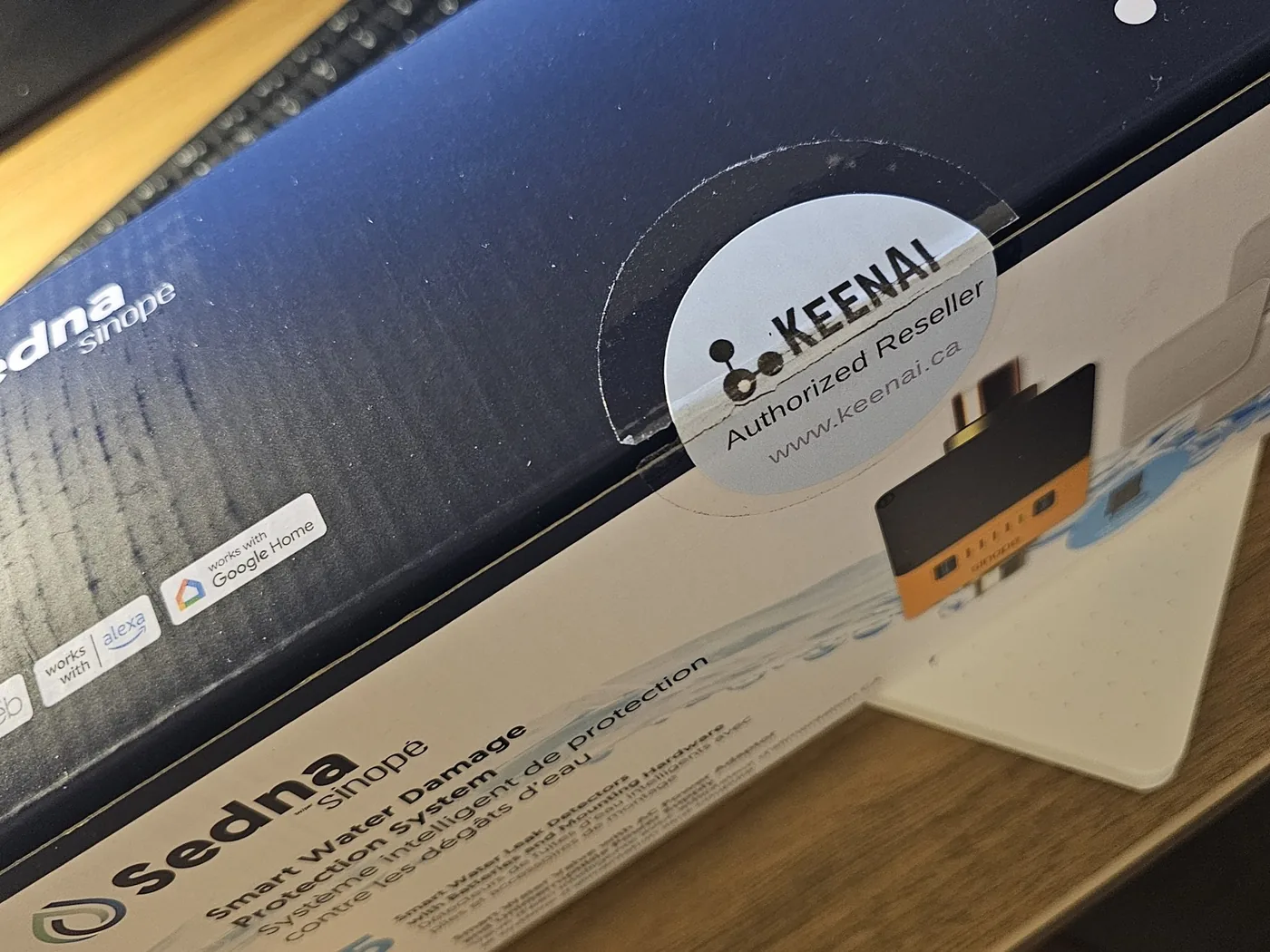
We are a Sinopé authorized reseller
Sedna hardware going out on one of our jobs, with our own reseller sticker on the carton. It means we specify, supply, install and support the same system — there is no third party to point at when something needs attention.
Where the water usually comes fromRanked by what we are actually called to
- Supply lines to washing machines and dishwashers. Braided hoses fail without warning and run at full pressure until something stops them.
- Water heaters. Tanks fail from the bottom, usually quietly, usually into a room nobody enters daily.
- Toilet supply and fill valves. Slow, constant, and frequently discovered by the tenant below rather than the one above.
- Vacant and seasonal units. No one is there to hear the alarm, which is exactly why the valve has to close on its own.
- Frozen pipes in shoulder seasons. The failure happens on the thaw, not the freeze — which is why a 5 °C warning is worth more than a burst-pipe alert.
How a building job runs
Free building assessment
We walk the mechanical room and a representative sample of suites, look at how the water is distributed, and identify the shut-off points and detector locations that matter.
A staged plan and a fixed quote
Priced per unit against that plan, so a board or owner can approve a first phase, prove it, and extend without re-engineering anything.
Installation with minimal disruption
Valves fitted and detectors placed suite by suite, coordinated with your building manager and scheduled around tenant access. Plumbing work is carried out by licensed trades.
Handover to whoever is on call
Alerts routed to the people who actually respond, the platform set up with the right access for board or management, and the as-installed record handed over for your insurer.
Serving Saskatoon, Regina and across Saskatchewan
KeenAI is locally owned in Saskatoon and works throughout the surrounding communities including Warman and Martensville. For commercial and multi-unit projects we travel — Regina and other Saskatchewan centres are within our normal working area, and we will consider work further afield in Alberta where the project justifies it. If you are outside Saskatoon, ask and we will give you a straight answer about travel before you spend anything.
Behind KeenAI are 22 years of IT-infrastructure and smart-systems experience and 130+ projects delivered.
Frequently asked questions
How is commercial water leak detection different from a home system?
A home system protects one dwelling and answers to one owner. A multi-unit system needs a valve and detectors in every suite, automatic shut-off that works when nobody is home, mesh networking so the signal reaches suites a single access point could not, and one management view so a property manager sees which unit raised the alarm rather than relying on individual tenants’ apps.
How many units can one water leak detection system cover?
The system is designed to scale unit by unit across a whole building, with each valve extending the mesh for the valves beyond it. Sinopé states that each valve supports up to twenty detectors and smart devices, but does not publish a maximum number of units per system — so the practical limit for your building is something we establish at the assessment rather than quote from a brochure.
Does the leak detection system work if the internet goes down?
Detection and shut-off happen locally between the detector and the valve, so a leak is still stopped when the building’s internet is out. What pauses is the notification and the management view; both resume automatically when the connection returns.
Will an automatic water shut-off valve reduce the building’s insurance premium?
Often it helps. Several Canadian insurers — including Allstate, Aviva, Intact and RSA — offer reduced premiums for properties with flow-interrupting leak protection, with discounts commonly quoted in the range of 2–15% per device or category. These systems are still relatively new to Canadian commercial underwriting, so there is no single guaranteed figure. We provide documentation of exactly what was installed; your broker confirms what your policy allows.
Can a leak detection system be installed in an occupied building?
Yes, and most of our multi-unit work is retrofit. There is no head-end control panel to accommodate, valves go on existing supply lines, and work is scheduled suite by suite around tenant access so no one loses water for longer than the fitting takes.
What happens when a valve closes at 2am?
The alarm sounds in the suite, the notification identifies the unit, and the water stays off until someone attends. Nothing depends on a tenant being awake, being home, or having installed an app.
Find out what one burst line would cost this building
A free building assessment gives you a per-unit plan, a fixed price and a staged path — plus an honest view of which suites carry the most risk today.
Commercial security cameras · Access control · Leak protection for houses